The web gave us hyperlinks, but not contextual traversal. AI may finally change how we navigate structured knowledge.
The original promise of Ted Nelson’s “hypertext” was never just that documents could link to each other.
The deeper idea was that humans don’t always traverse information in a single (printed) linear path. And now with the emergence of digital media, we have discovered the link.
Books have a fixed sequence, along with maybe footnotes, an index, and a glossary. Web pages have some visual layout and structure populated with clickables. And a rich knowledge graph sometimes only results in a springy curious cloud of labelled nodes and edges, for example:
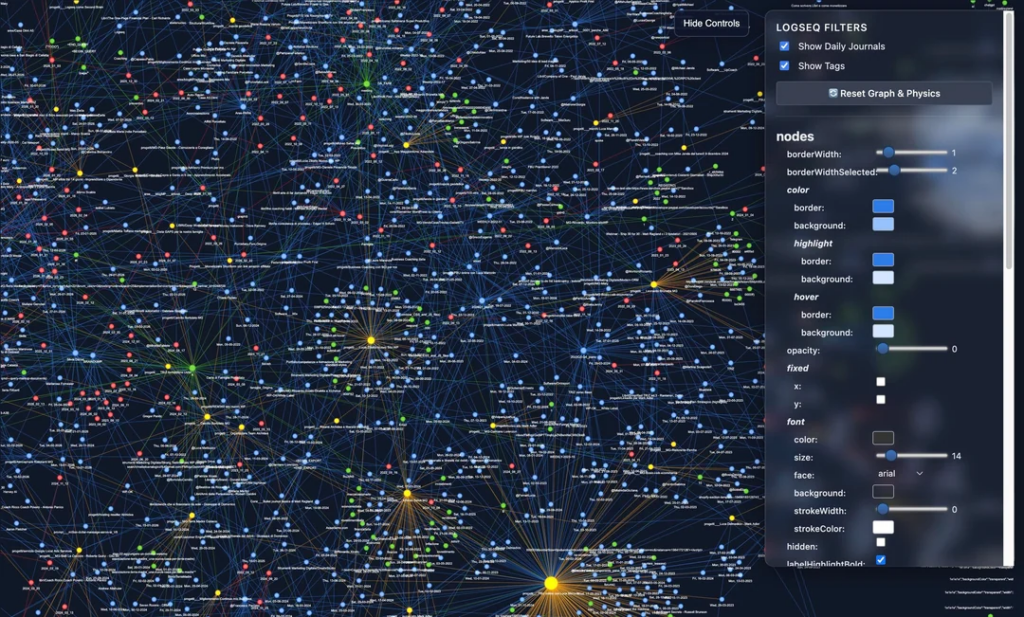
A human with the goal of learning, understanding, and leveraging has a unique and growing understanding of the material they are digging into. They may know very little needing to be guided, or they may be an expert, drilling into some deep detail. The path a person needs to navigate through a body of information depends on their question, their background, and their current goal.
In grad school, I ran a small cogsci study built on body of knowledge presented to people in one of two ways, linearly, or as a set of interconnected documents. The result was those who were new to the information learned better with the linear treatment, while the experts gained more insight using the hypertext. It makes sense, the experts have the cognitive map, the novices get lost.
AI is a new participant in the world of human knowledge now. It is an information reader and creator, and it provides a new host of possibilities for delivering understanding (and also consuming it).
Hyperlinks
Modern knowledge systems have become very good at storing information. But rendering it for people is a realm more imagined than real.
A knowledge graph represents relationships:
A → related to → BA hyperlink represents a possible traversal:
"Click here to go to B"But neither answers the question:
Why should I go from A to B right now?
That question depends on context.
Over time we’ve encountered many different ways of capturing and navigating the knowledge graph:
- Memex
- Project Xanadu
- transclusion
- hypertext
- stretchtext
- knowledge graphs
- RAG systems
- AI agents
A researcher studying the history of information systems might navigate:
Bush → Memex → Engelbart → Nelson → Xanadu → WebA software architect designing an AI knowledge system might move through those concepts in a different way. And a product designer another way, yet in all cases traversing through some of the same nodes of the graph.
The nodes are the same.
But the path and even between the same two nodes, the meaning and tone can emerge from the user’s perspective and agenda.
The link between two chunks of knowledge can be categorized like “starred in”, or “implemented by”, or “is related to”, but based on on the unique pursuit and experience of the user, the transitional sentence(s) can be handled differently.
This may explain why many ambitious knowledge systems have struggled to become mainstream. The challenge was never only storing more connections.
It’s managing the exponential explosion meanings between them.
Early hypertext pioneers recognized this problem. Systems such as those envisioned by Vannevar Bush and Ted Nelson were attempting to move beyond static documents toward information environments where relationships and context mattered. And “Choose your own Adventure” books are printed evidence of how a book of 100 pages would end up being a collection of short stories that all had some paragraphs in common!
Creating those relationships required enormous human effort as evidenced by the years it takes to build a significant “open world” video game.
Someone had to decide:
- what should connect,
- why it should connect,
- how it should be explained,
- and which path was useful for which audience.
That’s why taking on the challenge has always been labelled a “brave choice” by the onlookers.
One of the amazing aspects of artificial intelligence, is that, like a human, if you ask it to compare and contrast two concepts, it will, in a non-deterministic, practically non-repeatable way, produce a reasonable answer, most often more thoroughly than your average eighth grader!
AI can can generate explanations, summaries, comparisons, and transformations between concepts.
This suggests way to avoid that space and effort complexity issue of O(n^2):
Given only 10 “knowledge nodes”, if you had a single directed link between each pair of nodes, that would be n(n-2) (90) directed edges. In other words 90 meaningful transitions between them! It’s tough enough just to label the edges. Writing a compare and contrast for each? Not happening.
Enter the Prolific Co-Writer
Instead, if an LLM was given those nodes and a specific goal for a specific human inquirer, it could produce a custom personalized “adventure” through those them, writing up the very specific and useful transitional phrases between the concepts.
concept f -> LLM transition -> concept b -> LLM transition -> concept e ...With any knowledge graph, an LLM can produce a focused and meaningful path for the user.
Chatbots, have no qualms about politely repeating themselves, ad nauseum, saying practically the same thing over and over. Current systems produce the structure, and now AI can produce the usable meaning.
The same underlying body of information may appear as:
- a tutorial,
- a reference,
- a design document,
- a historical timeline,
- a technical design,
- a product explanation,
- or an exploration of related ideas.
While the multidimensional structure of the constellation of knowledge can be a simple database, it can be the source of projections, turning it into a linear or filtered path for our human brains.
Perhaps the next generation of knowledge systems will combine three ideas:
Structured knowledge
The underlying concepts and relationships are explicitly represented.
Contextual traversal
The path through that knowledge changes based on purpose.
Adaptive rendering
The same knowledge can be presented in different forms without duplicating content.
The web solved publishing. Search solved finding.
It’s pretty clear to me that AI has already and will continue to make knowledge sharing better.
The questions that maybe have a little more clarity:
Why didn’t Xanadu make it? Why didn’t stretchtext become an early component of HTML? Why are we traversing documentation by expanding tree icon tables of contents (that often scroll away), clicking on links, leaping to a whole new page or transporting to some anchor far below, hoping to not lose the thread of thinking, and risking that the back arrow will truly take you back but not too far?
With the progress of artificial thinking machines that we have come to rely on daily, can we can now build the systems that are less about search and discovery, where the connected web of knowledge tools don’t hand you a surfboard, but a canoe and a curated river ride taking you where you wanted to go?
I think it’s time.
Related References
- Bush (1945) – associative knowledge navigation
- Engelbart (1962) – augmentation and knowledge work
- Nelson (1965/1981) – hypertext and transclusion
- Berners-Lee (1989) – the Web’s simplification
- Hogan et al. (2021) – knowledge graphs
- Lewis et al. (2020) – RAG
Yes, I’m aware that these aren’t linked!
Leave a Reply